Publish Date: 06-05-2026
Renter's insurance
Last Updated: 15-09-2026
Does Renters Insurance Cover Car Theft?
The straightforward answer is no. Renters insurance does not cover the theft of your vehicle itself. However, if personal belongings such as your phone, laptop, jewelry, or other covered valuables are stolen from your car, renters insurance may cover them under your personal property coverage, subject to your policy's limits, deductible, and exclusions.
The extent of coverage for belongings stolen from your car can depend on where the theft occurred and whether you have endorsements, such as scheduled personal property coverage, for certain high-value items.
In this guide, you’ll learn what renters insurance covers when belongings are stolen from a car, what it doesn’t cover, and when you need auto insurance to protect your car.
What Does Renters Insurance Cover if Your Car is Stolen?
Whether you’re planning to buy a renters insurance policy, upgrade your coverage, or file a claim, it’s important to understand what renters insurance covers when personal belongings are stolen from your car.
While renters insurance does not cover the car itself, it may cover personal belongings that were stolen from your car. Let’s break down how renters insurance applies to stolen personal belongings.
Your Personal Belongings Inside the Car
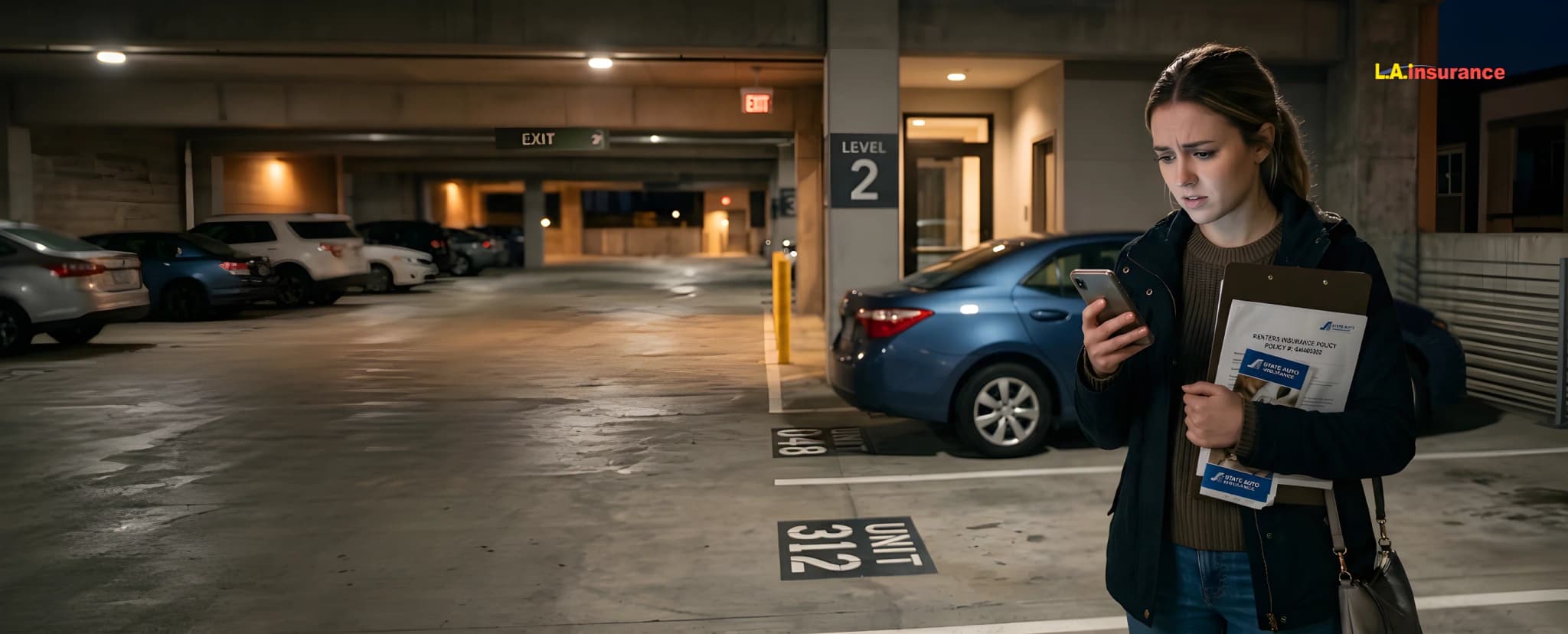
If your car is stolen or broken into, your renters insurance policy may reimburse you for items that were inside at the time of the theft under personal property coverage. This typically includes everyday items and valuables you carry with you.
Common examples of covered personal belongings include:
- Smartphones and tablets
- Laptops and other electronics
- Backpacks, handbags, and luggage
- Clothing and shoes
- Jewelry and watches
- Headphones and accessories
- Work or school-related items
- Sports gear or gym equipment
In general, most personal belongings you own can be covered, as long as they are not permanently attached to the vehicle. Items like your car’s sound system, seats, wheels, or other structural and mechanical components are considered part of the vehicle and are not covered under renters insurance.
Learn More: What is Renters Insurance and What Does it Cover?
On-Premises vs. Off-Premises Coverage
The location of the theft affects how much your renters insurance will pay for stolen belongings. Most policies cover personal property both on-premises (at your residence) and off-premises (away from home), but the coverage limits differ.
On-premises coverage generally applies to items stolen from inside your rental unit or areas directly attached to it. For belongings stolen from your car, this typically applies only if the vehicle is parked in a private garage that is part of your rental.
Off-premises coverage applies when your belongings are stolen outside your home, such as from a car parked in a shared apartment parking lot, on the street, or in a public area. Some policies limit off-premises coverage to around 10% of your total personal property coverage.
For example, if you have $20,000 in personal property coverage, your off-premises limit may be around $2,000. So, items stolen from your car in a parking lot would be covered under that lower limit, subject to your deductible.
Actual Cash Value (ACV) vs. Replacement Cost Value (RCV)
When it comes to covering stolen personal items in your car, the amount your renters insurance pays depends on whether your policy uses Actual Cash Value (ACV) or Replacement Cost Value (RCV).
With Actual Cash Value (ACV), your insurer reimburses you based on the item’s current value at the time of the theft, after factoring in depreciation. For example, if you bought a laptop for $1,200 three years ago and it’s now worth $500, that’s roughly the amount you’ll be reimbursed if it’s stolen from your car.
With Replacement Cost Value (RCV), your insurer covers the cost to replace the item with a new one of similar kind and quality, without deducting for depreciation. Using the same example, if a comparable new laptop now costs $1,200, your policy would cover that full replacement cost (subject to your deductible and policy limits).
In many standard renters insurance policies, personal property is covered on an ACV basis by default, with the option to upgrade to RCV coverage. Some high-value items may also qualify for replacement cost coverage when added through endorsements like scheduled personal property.
Deductibles and Coverage Limits
Even if your renters insurance covers items stolen from your car, the amount you actually receive depends on how your policy applies limits and deductibles to the claim.
For losses that happen away from home, like a car break-in or theft, your payout is first capped by your off-premises limit, which is often around 10% of your total personal property coverage. On top of that, certain items like jewelry or electronics may be further restricted by category-specific caps or sublimits.
For example, if $2,500 worth of belongings are stolen from your car, but your off-premises limit is $2,000 and one of the items exceeds a category cap, your eligible claim amount could be reduced before anything is paid out.
After those limits are applied, your deductible is subtracted from the remaining amount. So, if your final covered loss is $2,000 and your deductible is $500, your insurer would typically reimburse $1,500.
These adjustments can reduce your final payout below the total value of the stolen items. It’s important to understand how these adjustments work to better estimate what you’ll actually receive after a theft.
Why Doesn’t Renters Insurance Cover Car Theft?
Renters insurance does not cover car theft because it is designed to protect your personal belongings, not vehicles. Cars are treated as a separate category of property that requires specialized coverage.
This is mainly because vehicles come with different risks, such as accidents, liability, and higher theft exposure, which are specifically handled under an auto insurance policy.
For this reason, car theft is excluded from renters insurance and is instead covered under comprehensive auto insurance coverage.
Do You Need Auto Insurance to Cover Car Theft?
Yes, you need auto insurance to cover car theft, as it is specifically handled under comprehensive coverage. Car theft is also more common than many people assume.
According to the Insurance Information Institute (III), and National Insurance Crime Bureau (NICB), vehicle thefts in the U.S. have still remained high in recent years:
Year | Estimated Number of Vehicle Thefts |
2020 | 880,595 |
2021 | 932,329 |
2022 | 1,008,756 |
2023 | 1,020,729 |
2024 | 850,708 |
| 2025 | 659,880 |
Although vehicle thefts declined in 2025, 659,880 vehicles were still stolen, which is a significant number. This shows the importance of having appropriate car insurance coverage.
If you don’t have comprehensive auto insurance and your car is stolen, you would have to bear the full financial loss. This can be even more serious if your vehicle is financed, as you may still be responsible for paying off the remaining loan balance out of pocket.
Learn more: Does auto liability insurance cover theft?
Renters Insurance vs Auto Insurance for Theft Coverage
When it comes to theft coverage, renters insurance and auto insurance serve different purposes. The table below highlights the key differences between these two policies and when each one applies in a car theft incident.
Coverage Aspect | Renters Insurance | Auto Insurance |
What it covers | Personal belongings inside your car | The car itself |
Type of theft covered | Theft of items (e.g., phone, laptop, bags) | Theft of the vehicle |
Where coverage applies | On-premises and off-premises (including your car) | Anywhere the car is stolen |
Coverage limits | Subject to policy limits and off-premises limits (10%) | Based on vehicle’s actual cash value (ACV) |
Deductible | Applies to personal property claims | Applies to comprehensive coverage claims |
Required for theft coverage | Not required for vehicle theft | Comprehensive coverage is required |
| Broken window/damage from break-in | Not covered | May be covered by comprehensive coverage |
Coverage for car parts (e.g., wheels, stereo) | Not covered | Covered under comprehensive |
High-value items | May have sub-limits unless scheduled | Not applicable |
Best for | Protecting personal belongings | Protecting the vehicle itself |
Based on the overall comparison, if your car gets stolen, renters insurance will protect your stuff, and auto insurance will protect your car.
Is It a Good Idea to Combine Car Insurance and Renters Insurance for Better Protection?
Yes, combining car insurance and renters insurance can be a smart way to get broader protection for your car and personal belongings, especially when it comes to theft. While renters insurance covers your personal belongings, auto insurance (specifically comprehensive coverage) protects your vehicle itself.
When you have both policies, you’re covered from both angles. For example, if your car is stolen, your auto insurance can cover the loss of the vehicle, while your renters insurance may reimburse you for any covered personal items inside the car.
Bundling both policies can also help you save money, as many insurers offer multi-policy discounts. In addition, managing both policies with the same provider can make the claims process simpler, especially if a single incident affects both your car and your belongings. Overall, combining renters and auto insurance gives you broader protection, added convenience, and potential savings.
Overall, combining renters and auto insurance gives you added protection, greater convenience, and potential savings.
How to File a Renters Insurance Claim for Personal Belongings Stolen from a Car?
If you have renters insurance and your personal belongings are stolen from your car, you should file a claim as soon as possible. Since theft is a criminal incident, the claims process typically begins with filing a police report, followed by a few key steps. Here’s a step-by-step guide to claim renters insurance for stolen items from your car.
- File a police report immediately: Your insurer will usually require a copy of the police report to verify and process your claim.
- Document the stolen items: Make a detailed list of everything that was stolen from your car, including descriptions, estimated values, and purchase dates if possible.
- Gather proof of ownership: Collect any receipts, invoices, photos, or bank statements that can verify you owned the stolen items. This helps support your claim and speeds up the process.
- Take photos and videos of the incident (if applicable): If your car was broken into, take pictures or videos of any damage or signs of forced entry. This can serve as additional evidence.
- Contact your insurance provider: Notify your insurer and start the claims process. You can usually do this online, through a mobile app, or by calling your insurance agent.
- Complete the claim form: Fill out the required claim forms and provide all requested details about the incident and the stolen items.
- Cooperate with the claims adjuster: Your insurer may assign a claims adjuster to review your case. Be prepared to answer questions or provide additional documentation if needed.
- Receive your claim settlement: Once your claim is approved, you’ll receive a payout based on your policy’s coverage, limits, and deductible.
Tips to Prevent Car Theft and Protect Your Belongings
While you can’t completely prevent car theft, you can take proactive steps to reduce the risk and better protect your belongings. Here are some practical tips to help keep your car and personal items secure.
- Always lock your car and double-check before leaving.
- Avoid leaving valuables visible inside your car.
- Park in well-lit, secure, and high-traffic areas.
- Use anti-theft devices like steering wheel locks or alarms.
- Keep windows fully closed when the car is unattended.
- Do not leave spare keys inside or near your vehicle.
- Install a GPS tracker or vehicle recovery system.
- Take valuables with you instead of leaving them in the car.
- Use tinted windows or covers to hide items from view.
- Be cautious when parking in unfamiliar or high-risk areas.
Final Tip: Protect Your Car and Belongings the Right Way
If you’re living on rent, and if you have a car, it’s important for you to have both auto and renters insurance policies to stay financially covered against accidents and criminal incidents like theft and vandalism.
Car thefts and vehicle break-ins are quite common, so both policies are necessary for balanced financial protection. This is mainly because renters insurance may cover eligible personal belongings stolen from your car, while auto insurance with comprehensive coverage generally protects the car itself.
Now, if you’re considering getting these two insurance policies, it’s best to acquire them from the same insurer. Also, if you need help or if you’re interested in purchasing an affordable renters and car insurance policy with the right coverage, you can contact us for a free quote and expert guidance.
Frequently Asked Questions (FAQs)
Will renters insurance cover my car?
Renters insurance does not cover your car itself. It only covers your personal belongings, so if items inside your car are stolen, they may be covered, but damage to or theft of the vehicle requires auto insurance (specifically, comprehensive coverage).
What happens if you rent a car and someone steals it?
If a rental car is stolen, you’re typically responsible for the loss unless you have coverage. This can come from the rental company’s loss damage waiver (LDW/CDW), your personal auto insurance (comprehensive coverage that extends to rentals), or certain credit cards that offer rental car protection. Without any of these, you may have to pay for the vehicle’s value and related fees.
Does renters insurance cover stolen items from a rental car?
Yes, renters insurance may cover your personal belongings stolen from a rental car, as long as they meet your policy’s conditions and limits.
Does renters insurance cover items stolen from a locked car?
Yes, renters insurance can cover stolen items even if your car was locked. However, insurers may require proof of forced entry in some cases, especially for high-value claims.
Does renters insurance cover a car break-in?
Yes. Renters insurance may cover personal belongings stolen from your car during a break-in under personal property coverage. However, it generally does not cover damage to the car itself, such as a broken window or damaged lock, which may be covered by comprehensive auto insurance.
Does renters insurance cover cash stolen from my car?
Cash may be covered, but it is usually subject to very low limits under most renters insurance policies. Some policies may not cover cash at all, so it’s important to check your specific policy.
Does renters insurance cover stolen work equipment from my car?
It may cover work-related items if you own them personally. However, equipment owned by your employer may not be covered under your renters insurance policy.
Editorial Disclaimer
The information provided on this blog is for general informational purposes only and does not constitute professional insurance, legal, or financial advice. Coverage and rates are subject to individual eligibility, underwriting guidelines, and state availability. For specific questions regarding your policy or to get an accurate quote, please contact a licensed L.A. Insurance agent directly. We're an independent agency and not a direct insurance carrier. For more information on how we operate and handle your data, please see our Terms and Conditions and Privacy Policy.
Tag :
fast car insurance
Renter's insurance

What is Permanent Life Insurance?
Wouldn’t it be helpful to have a life insurance policy that provides lifelong coverage and can also build cash value over time? That’s where permanent life insurance comes in.

What is Term Life Insurance?
Term life insurance is a type of life insurance policy that provides coverage for a specific period, generally 10, 15, 20, 30, or even 40 years.

Types of Life Insurance and How They Differ?
If you’re shopping for life insurance, you’ve probably come across different types of life insurance, such as term life insurance, whole life insurance, and universal life insurance.

What Is Life Insurance?
If you’re thinking about getting a life insurance policy, it’s important to understand what it is and how it works. Simply put, life insurance is a type of financial protection that provides money to your chosen beneficiaries after your death.

Does Car Insurance Cover Rust Damage?
Rust can damage many parts of your car and may become more severe over time if left untreated.
Does Insurance Cover a Tree Falling on Your Car?
Whether your car is parked out in the open under or near a tree, or you’re driving when a tree suddenly falls on your car, either way, it can leave your car severely damaged or even wrecked.