Publish Date: 26-04-2026
Auto Insurance
Last Updated: 06-09-2026
11 Reasons Why Car Insurance Is So Expensive in Florida?
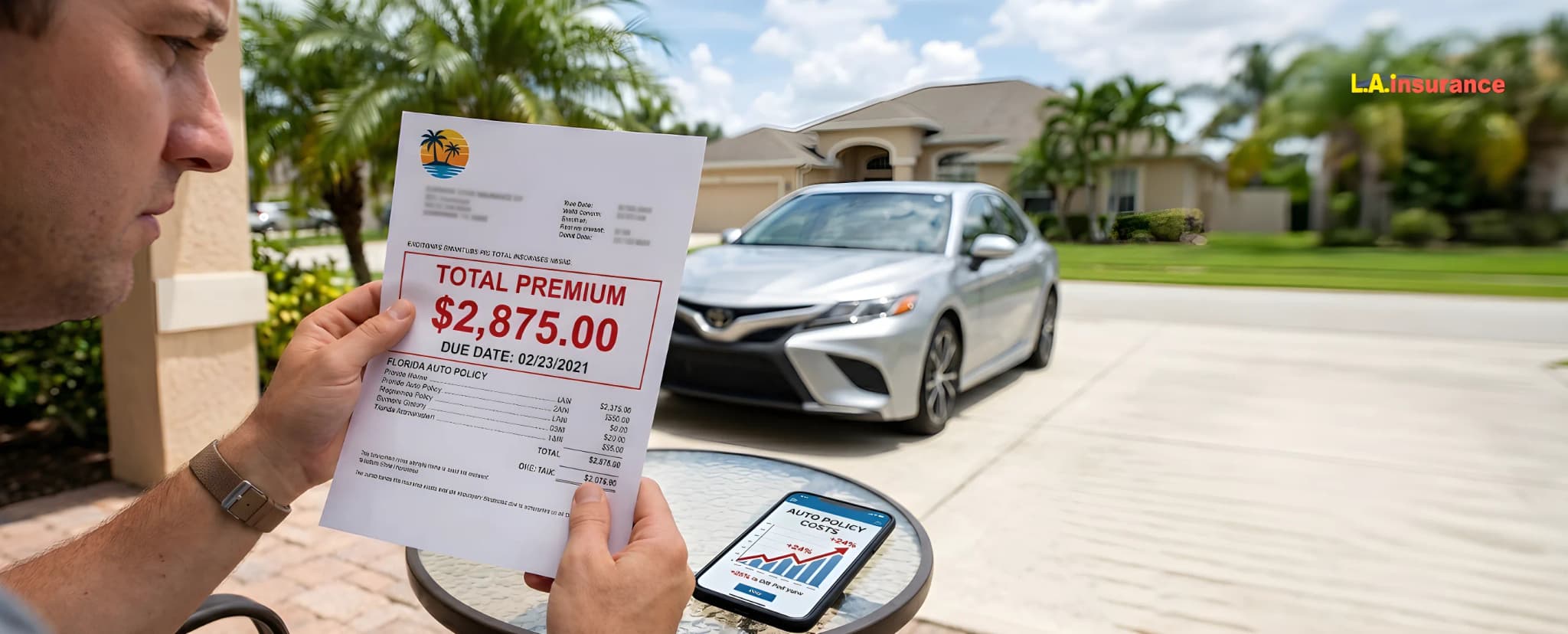
When it comes to car insurance, Floridians pay about 62% more than the national average. As of April 2026, Bankrate data shows drivers in Florida pay around $88 per month for minimum coverage and about $324 per month for full coverage. That’s significantly higher than what drivers pay in most other states. In fact, data from the Insurance Information Institute (III) ranks Florida as the most expensive state for car insurance.
So why are car insurance rates in Florida so high? Florida is a high-risk, high-cost state for insurers. There are more accidents, more uninsured drivers, higher medical bills, and frequent storm damage. All of that increases claim costs. On top of that, fraud, lawsuits, and expensive repairs keep pushing Florida auto insurance premiums higher.
In this article, we’ll break down exactly why car insurance is so expensive in Florida and what’s really driving your rate.
Why Is Car Insurance So Expensive in Florida?
Car insurance in Florida is high because multiple risk and cost factors stack together. These increase claim frequency and payouts, which pushes premiums higher across the state.
- High Number of Uninsured and Underinsured Drivers
- Frequent Accidents and Dense Traffic
- Expensive Personal Injury Protection PIP System
- Insurance Fraud and Staged Accidents
- Severe Weather Risks
- Reinsurance Costs
- High Vehicle Theft Rate in Florida
- Inflation
- Rising Vehicle Repair and Replacement Costs
- Assignment of Benefits AOB Abuse
- Population Growth and Tourism Impact
1. High Number of Uninsured and Underinsured Drivers
Florida has a serious uninsured and underinsured driver problem, and it plays a big role in rising costs.
As of May 2026, Florida Highway Safety and Motor Vehicles (FLHSMV) reports about 835,554 uninsured motorists, or roughly 4.98% of registered drivers. But broader industry data shows the issue is much bigger. The Insurance Information Institute estimates that about 20.6% of Florida drivers are uninsured, which means nearly one in five drivers has no coverage at all.
That’s not the end of the picture. Florida also has a high number of underinsured drivers. Around 38.3% of drivers don’t carry enough coverage to fully pay for accident damages.
When one of these drivers causes a crash, insurance companies still have to cover the loss through uninsured motorist protection or other coverage. That increases total claim payouts across the Florida insurance market. Over time, those higher costs get built into pricing.
As a result, car insurance rates in Florida go up for everyone, even for drivers with clean records.
2. Frequent Accidents and Dense Traffic
Florida roads stay busy year-round, and that leads to more crashes than most states.
As of May 2026, data from the Florida Highway Safety and Motor Vehicles crash dashboard shows nearly 121,511 crashes and 856 fatalities already this year. That’s a high volume in a short time, especially when compared to many other states.
Several factors drive this. Florida has dense urban traffic, constant population growth, and heavy tourism. More drivers on the road means more chances for accidents. Even minor collisions add up quickly.
Since insurers set your car insurance price based on the risks you face every day, Florida’s high accident rates and congested traffic lead to more claims and larger payouts across the system. Over time, insurers factor that added risk into policy pricing, which drives premiums higher statewide.
3. Expensive Personal Injury Protection PIP System
Florida follows a no‑fault insurance system, which requires drivers to carry $10,000 in personal injury protection (PIP) coverage. After a crash, your own insurer must pay at least 80% of medical bills, regardless of who was at fault, and there’s no deductible.
This setup leads to more frequent claims. Even minor accidents can trigger payouts, and Florida’s high medical costs make those claims especially expensive. In fact, the Center for Medicare and Medicaid Services reports that Florida has some of the highest healthcare costs in the country ($13,652).
Since insurers are obligated to cover 80% of medical bills in a state with some of the nation’s highest healthcare costs, claim payouts quickly add up. To offset those losses, insurers raise premiums, making Florida’s PIP system one of the key drivers of higher auto insurance rates.
4. Insurance Fraud and Staged Accidents
Insurance fraud is a major reason why car insurance rates in Florida stay high, and staged accidents are a big part of that problem.
Estimates show that auto insurance fraud costs Florida around $2 billion each year, adding roughly $1,300 annually to the average family’s premium. On top of that, about 1 in 10 PIP claims are considered fraudulent, which shows how widespread the issue is. The National Insurance Crime Bureau (NICB) reports that over 600 “questionable claims” are filed each year in Florida.
Staged accidents often involve organized schemes where crashes are planned or exaggerated, followed by inflated medical treatments billed through the PIP system.
Litigation makes things even worse. Florida sees a high number of lawsuits linked to injury and PIP claims. Legal fees, settlements, and drawn-out cases increase the total cost of each claim.
As fraud and legal costs pile up, insurers are forced to pay more per claim. Those losses don’t stay with the companies. They get built into pricing, which pushes car insurance rates in Florida higher for everyone.
5. Severe Weather Risks
Florida possesses over 1,350 miles (2,170 KM) of coastline. These long, low-lying areas put millions of vehicles at risk during hurricanes, flooding, and severe storms.
Hurricanes alone cause massive losses. For example, Hurricane Ian in 2022 led to $115 billion in total damages. It was, in fact, the third costliest cyclone in U.S. history.
Apart from just Ian, flash floods, storm surge, tornadoes, hail damage, and wildfires frequently damage vehicles in Florida. And these events trigger large spikes in claims. Flooded cars are often totaled, and even minor storms can lead to thousands of comprehensive car insurance claims across the state.
Because storm losses in Florida happen often and on a large scale, insurers anticipate higher payouts and price that risk into policies upfront. Eventually, repeated damage and rising claim costs drive premiums higher for everyone, even those who have never filed a weather‑related claim.
6. Reinsurance Costs
Reinsurance costs are a major driver of high premiums in Florida.
Insurers buy reinsurance to protect themselves from large losses, especially from hurricanes and severe storms. Because Florida faces frequent catastrophe risk, backup coverage is expensive. In fact, reports show Florida accounts for a large share of global reinsurance losses, which pushes prices higher for insurers operating in the state.
When reinsurance costs rise, insurers pass those expenses directly into pricing.
So, this added financial pressure pushes car insurance rates in Florida higher, even if your personal driving risk stays the same.
However, fortunately, the new 2026 legal reforms have reduced frivolous litigation, and as a result, the Florida carriers' reinsurance rate has dropped by 10% to 15%.
7. High Vehicle Theft Rate in Florida
Vehicle theft is another factor pushing insurance costs higher in Florida.
According to the Insurance Information Institute (III), Florida ranks among the top states for auto theft, with over 46,000 vehicle thefts reported in 2023, placing it #3 nationwide. That’s a high volume compared to most states.
Each theft turns into a claim, often for the full value of the vehicle. Even when cars are recovered, repair costs can still be significant.
As theft-related claims increase, insurers end up paying more under comprehensive coverage. To recover those losses, they raise rates, which leads to higher car insurance costs across Florida, especially in high-theft areas like Tallahassee, Miami, and Orlando.
8. Inflation
Inflation has elevated the cost of nearly every part of auto insurance in Florida.
Vehicle prices rose sharply in recent years, with used car values increasing more than 30% at one point, according to Bureau of Labor Statistics data. Repair costs also climbed as parts and labor became more expensive. Many auto parts are still imported, so supply chain issues and 25% tariffs on imported components have added to those costs.
Medical care is more expensive as well, which increases the cost of injury claims.
As insurers pay more for repairs, replacements, and medical expenses, they adjust rates to cover those higher payouts. That’s one of the key reasons car insurance rates in Florida continue to rise.
9. Rising Vehicle Repair and Replacement Costs
Vehicle repair and replacement costs have climbed sharply, and that’s one of the reasons insurance rates keep rising in Florida.
Repair bills increased about 3% to 4% in 2024, with labor costs rising even faster due to technician shortages. Parts costs have surged as well, with some estimates showing close to a 20% to 25% increase since 2020. That makes even routine fixes more expensive.
Modern vehicles add to the problem. Sensors, cameras, and advanced systems turn minor damage into costly repairs that require recalibration and specialized labor. Replacement costs are higher too, since insurers must pay the current market value when a car is totaled.
As insurers pay more per claim than they did just a few years ago, they adjust rates to cover those higher costs, which leads to higher car insurance rates across Florida.
10. Assignment of Benefits AOB Abuse
Assignment of Benefits (AOB) abuse has been a long-running issue in Florida and a key reason insurance costs remain high. AOB allows a third party, like a medical provider or repair shop, to take over a claim and bill the insurer directly. In Florida, this system has often been misused through inflated bills and unnecessary treatments, especially under the PIP system.
This also led to a surge in lawsuits. At one point, Florida accounted for a large share of the nation’s AOB-related litigation, which is driving up legal and claim costs for insurers. Even with recent reforms to limit abuse, the impact still lingers. Insurers continue to factor in those higher past and ongoing costs, which contribute to higher car insurance rates across the state.
11. Population Growth and Tourism Impact
Florida’s rapid population growth is adding more pressure on its roads. The state’s population has grown by about 8% since 2020, reaching over 23 million residents, according to U.S. News & World Report. More residents mean more vehicles, more daily commutes, and a higher chance of accidents.
Tourism adds another layer. Florida welcomed a record 143.3 million visitors last year. Many of these drivers are unfamiliar with local roads, which increases accident risk. With more cars on the road year-round, insurers face more frequent claims, and those higher costs lead to increased car insurance rates across Florida.
Is Florida Car Insurance Rate Going Down in 2026?
There are early signs of relief, but the drop is modest and not guaranteed for everyone. Florida’s top auto insurers are indicating an average rate decrease of about 8% in 2026, following a similar drop of around 7.4% in 2025.
Governor Ron DeSantis has pointed to recent legal and insurance reforms as the main reason behind these changes. Several major insurers have already filed rate cuts, including State Farm, Progressive, and AAA, with some reductions ranging from 4% to over 10% depending on the company.
The reason behind this shift is improving market conditions. Fewer lawsuits, lower claim losses, and more insurers entering the market have helped stabilize pricing. Still, Florida remains a high-risk state, so while rates may ease slightly in 2026, they are still higher than most of the states.
Factors You Should Consider to Reduce Auto Insurance Costs in Florida
If you’ve been struggling to find affordable insurance in Florida, you’re not alone. Evidently, the state is expensive, but not everything depends on the insurer. There’s still a lot you can control on your side.
Apart from the reasons we’ve already covered, a few key factors directly affect how much you pay. If you pay attention to them, you can lower your auto insurance costs. Typically, your rate depends on:
- Your age
- Your location
- The type of car you drive
- Your driving and claims history
- Your credit score and financial responsibility
Age plays a big role. Younger drivers under 25 and older drivers tend to pay higher premiums because they are considered higher risk. If possible, staying on a family policy or maintaining a clean driving record can help reduce costs.
Location matters just as much. Living in high-traffic areas like Miami or Orlando often means higher premiums due to more accidents, theft, and claims. Moving to a lower-risk ZIP code, if practical, can make a noticeable difference.
Your vehicle and its make and model also affect your rate. Cars with high repair costs or advanced technology are more expensive to insure. Choosing a reliable, lower-cost vehicle can help keep premiums down.
Your claims history is another major factor. Frequent claims signal higher risk. Avoid filing small claims when possible, especially if the repair cost is close to your deductible.
Finally, your credit score plays a role in Florida. Drivers with better credit-based insurance scores often pay less. Improving your financial profile can help lower your overall premium.
Important Tips to Lower Your Florida Car Insurance Premium
You can’t control Florida’s risks, but you can control how insurers price you. So, try to focus on these practical tips:
- Compare car insurance quotes every year to avoid overpaying for the same coverage
- Increase your deductible to lower monthly premiums (if you can afford higher out-of-pocket costs)
- Bundle auto with home or renters insurance to save up to 10% to 25%
- Maintain a clean driving record to qualify for safe driver discounts
- Use telematics or safe driving programs to earn up to 20% discounts
- Avoid filing small claims that can raise your future premiums
- Improve your credit score to reduce your insurance rate over time
- Choose a higher deductible and adjust coverage wisely based on your car’s value
- Install anti-theft devices to lower comprehensive coverage costs
- Take a defensive driving course to unlock additional discounts
Learn more ways to lower your car insurance rates.
Why Is Auto Insurance So Expensive in Florida: The Bottom Line
To sum up, car insurance in Florida is certainly high-priced. Because multiple risks stack together, from uninsured drivers and frequent accidents to fraud, weather damage, and rising repair and medical costs. Insurers face higher payouts, and those costs show up in your premium. Although rates may ease slightly in 2026, Florida will remain a high-cost market. So, the best way to manage it is to compare options, adjust your coverage wisely, and look for affordable full coverage auto insurance that fits your budget. However, if you’re still unsure, consulting an insurance agent can help you find better rates without compromising coverage.
Why Floridians Pay High Auto Insurance Rates FAQs
How much is car insurance in Florida per month?
On average, drivers in Florida pay about $80 to $95 per month for minimum coverage and around $320 to $340 per month for full coverage. However, your exact rate will depend on many variables, including your driving record, age, location, credit score, and the type of coverage you choose. Drivers in high-risk areas often pay more.
Why is car insurance so expensive in Miami, FL?
Miami has some of the highest insurance rates in Florida because of heavy traffic, frequent accidents, high vehicle theft, and insurance fraud. The city also sees more lawsuits and claims than most areas. All of these contribute to higher auto insurance premiums.
What are some of the cheapest car insurance in Florida?
In Florida, several insurers are often cited as offering relatively lower rates, including L.A. Insurance, GEICO, State Farm, Progressive, and Travelers. The most affordable choice, however, depends on individual circumstances.
How can you find the cheapest auto insurance rates in Florida for young drivers?
Young drivers can lower costs by staying on a family policy, maintaining a clean driving record, and taking advantage of good student or safe driver discounts. Choosing a reliable, lower-cost vehicle and comparing multiple quotes also helps reduce premiums.
What auto insurance coverages are legally required for Florida drivers?
Florida requires $10,000 in Personal Injury Protection (PIP) and $10,000 in Property Damage Liability (PDL). Bodily injury liability is not mandatory for most drivers, but it’s strongly recommended because minimum coverage may not fully cover accident costs.
Editorial Disclaimer
The information provided on this blog is for general informational purposes only and does not constitute professional insurance, legal, or financial advice. Coverage and rates are subject to individual eligibility, underwriting guidelines, and state availability. For specific questions regarding your policy or to get an accurate quote, please contact a licensed L.A. Insurance agent directly. We're an independent agency and not a direct insurance carrier. For more information on how we operate and handle your data, please see our Terms and Conditions and Privacy Policy.
Tag :
Auto insurance
fast car insurance
cheap car insurance
car maintenance

What is Permanent Life Insurance?
Wouldn’t it be helpful to have a life insurance policy that provides lifelong coverage and can also build cash value over time? That’s where permanent life insurance comes in.

What is Term Life Insurance?
Term life insurance is a type of life insurance policy that provides coverage for a specific period, generally 10, 15, 20, 30, or even 40 years.

Types of Life Insurance and How They Differ?
If you’re shopping for life insurance, you’ve probably come across different types of life insurance, such as term life insurance, whole life insurance, and universal life insurance.

What Is Life Insurance?
If you’re thinking about getting a life insurance policy, it’s important to understand what it is and how it works. Simply put, life insurance is a type of financial protection that provides money to your chosen beneficiaries after your death.

Does Car Insurance Cover Rust Damage?
Rust can damage many parts of your car and may become more severe over time if left untreated.
Does Insurance Cover a Tree Falling on Your Car?
Whether your car is parked out in the open under or near a tree, or you’re driving when a tree suddenly falls on your car, either way, it can leave your car severely damaged or even wrecked.